Music is one of the most beautiful things on the planet. Seeing a live band perform will always be more fun and spiritual than just dancing along to pre-recorded music from a PA system. In the world of live music, ‘taping’ is a way to preserve the unique, God-given moments of live music. As a Christian, I must conduct myself ethically and state that concert taping should only be done with permission by the artist and venue. While I myself am guilty of ‘stealthing’ at concerts, I’ve lately been reaching out to the management of artists I’m seeing to attempt to get permission. Even getting in contact with management is easier said than done. But, I digress. Some bands openly allow it, such as Grateful Dead, Phish, Dave Matthews Band, moe., etc. For this, I am both extremely grateful and impressed.
Now, there are two ways to tape. The first one is to record directly from the soundboard (SBD). Some artists are cool with this, many are not. For instance, my mother recently attended Calexico’s performance at the Community Concert Hall of Fort Lewis College in Durango, CO on October 24, 2024. While I was not present, someone did manage to grab a soundboard feed and record the show to share on archive.org. It’s worth mentioning that this specific “tape” is a matrix, more on that later. Many artists don’t offer connections to their soundboards, which brings me to method two: the audience tape (AUD). The audience tape is a truly fascinating concept.
When I first started trying to get into Phish’s music back in June 2022, I quickly noticed an unusual sight in many of the audience photos of their shows. I began to notice what looked a bit like flag poles at Glastonbury, but with no flags. Not only no flags, but instead… microphones? I thought this was the stupidest thing I’d ever heard of in my life. Then again, my only experience with a “real” microphone was a severely weathered Shure SM57 I’d borrowed from a friend. For those unaware, the Shure SM57 and SM58 are the same mic suited for different purposes. The 57 is flat at the end, great for shoving into the cone of a guitar cabinet driver, the 58 has a ball on the end meant for plosives and vocal use. This is the most common vocal microphone in existence. Every school, church, live sound reinforcement company and amateur podcaster has one. They’re cheap, rugged and sound very poor when compared to condenser microphones. SM57/58s are dynamic.
Simply put, there are many different types of microphones. There are different types within the different types… within the different types. I’m going to gloss over the technical jargon, as I’d just written a large summary of microphone types. Small diaphragm condensers pick up a very lifelike representation of the audio in question. Fast transient response at the expense of some self-noise. Large diaphragm condensers have a larger-than-life quality to them. These are favored by most vocalists in studios, as well as used where slower transients and lower frequencies are expected: bass amps, kick drums, deep brass, things such as these. Neither are used for live vocals much due to the fragile and sensitive nature of condenser mic circuitry. Basically, don’t slam them around.
Okay, so what am I getting at here? What’s the point? The idea is simply to record the concert from where you are in the venue. Different mics will provide different tonal qualities as well, and any slight movement or adjustments of where the mics are in space and where they’re pointed (for cardioid polar patterns) will change the sound of the recording exponentially. They’re exactly like light fixtures. Do we want a narrow beam, or do we want a flood? This is akin to the polar patterns of the microphones, which are essentially how much off-axis information they are sensitive to. What color temperature of the light? This is a comparison to the diaphragm size. Natural, or artificial sound? My comparisons are certainly not perfect, but I’m only human.
Finally, I’ll get to the fun and nerdy part of the article, I think. Phish is a band known for never performing the same concert twice. It’s worth slipping in here that Taylor Swift’s The Eras Tour ended exactly one week ago tonight and was likely the most choreographed and sequenced concert performance of all time. I really don’t have any issue with this. And while, I’m certainly no fan of Swift’s music, the rampant and concerning idolatry that her fans are so quick to immerse themselves in is creepy and a little scary to say the least. Ah, but I was once 17, too. What I’m saying is that it is not the norm to constantly pitch curveballs directly to your audience as fast as possible on a nightly basis. This is Phish’s favorite game, save for playing chess with their audience during their 1995 Fall Tour. To date, the band has performed over 1,800 times since December 2, 1983.
While the band has officially released SBDs of every show they’ve played since 2002, it’s through a subscription-based service, LivePhish.com. In my humble opinion, SBDs are a little bit of a cop-out when it comes to live recording. With every drum, cymbal, guitar cabinet and person’s mouth completely miked up and ready to go, there’s no additional effort needed to really do this. AUDs, however, are a completely different story. Let’s just run through a basic checklist of equipment necessary to record live concert audio here in… 2025, basically. Most tapers run a minimum of two mics. Two ears means we as humans were created by God to live in stereophonic sound. We have a sense of directionality and a sense of fullness when we listen to essentially anything.
Two mics, a stereo bar, a tall stand, XLR cables, a portable battery-powered recording device, SD card and a power source. Headphones are sometimes used to monitor the recording live as it happens, though this isn’t a practice I engage in often. All of this should fit in a backpack or case of some type. The taller the mic stand, the further from people’s chattering mouths the mics are. Also, the more direct they will be with being on-axis with the PA, usually. This collection of equipment can be called a “rig.” Most high-roller tapers use Schoeps (pronounced “sheps”) SDCs. For a pair of their MK4/CMC6 microphones, one is currently facing a hefty price tag of $3,300 as of December 15, 2024. For comparison, the SM57/58s I was referring to earlier are about $99 a piece. B&K (now known as DPA) is another popular manufacturer of extremely high-end microphones. Neumann (noy-min) is also a popular choice. The goal is the same no matter what rig one decides to assemble: record the best-sounding version of the concert from where they are in the venue and with what equipment they own.
When I attended a Halloween festival at Prescott, AZ’s now-defunct “The Den” music hall, I ran an unbelievably cheap rig consisting of Rode M5 matched stereo SDCs and a Zoom H4n Pro. Altogether, including the battery, this rig assembly cost less than $300. I managed to get a wonderful sonic “picture” of the event. Ten bands over the course of seven hours recorded in 48 kHz with a bit-depth of 24. To me, this is worth infinitely more than any t-shirt, any 45-second iPhone video, any fleeting memory of the event. Some argue you can’t catch magic, and I disagree. My ultimate goal as a taper is split among two objectives: archive it and share. These are equally important to me.
I have to archive sounds and words. Archiving is the only way to have anything that resembles time travel into the past. I deeply enjoy historical photos, videos, texts and, above all else, sounds. To capture the truest essence of a concert with all of its imperfections, all the missed notes, the banter, even some of the audience chatter is such a delight. I love knowing I can hop onto Archive.org or Phish.in and dive into the offerings of the mighty AUD. In fact, I will be reviewing Phish’s July 19, 1998 performance at Shoreline Amphitheatre, Mountain View, CA here within the next week, and I’ll elaborate slightly on the specific “source” (recording) of the show I’m most familiar with. It’s not uncommon at all for many different rigs to be running in the audiences of jam bands. I’d be willing to guesstimate that Phish’s early morning January 1, 2000 performance was very likely taped by well over 100 people in a crowd of at least 80,000. Back in the day, multiple sources made it faster and easier to grow the tape-trading tree. The goal is to share, remember? Napster didn’t exist until mid ‘99, MP3 players were barely coming out across the globe in ‘98. This meant exchanging email handles at shows and physically shipping blanks to those with master DAT (digital audio tape) sources and CD burners was the way to get it done back in the day.
Taping culture has dwindled exponentially. From my 27-year-old perspective, it’s a retro way to record shows. Most people want SBDs. They tolerated AUDs back in the day when that was the only way to spread the wealth, but nowadays, people want to be spoiled. They want that perfect-studio quality mix. I personally want to feel like I’m in seat 14, row B, section 202 or whatever. This makes it so much more special and intimate, to me. Now, I’ll clarify something. Phish still lets people tape, however, you have to have a “taper’s ticket” and must be in the OTS, the “official taper’s section.” This is just a fancy little area of the venue usually directly behind the sound booth. The reason for this section’s existence can be traced back to 1984. The Grateful Dead, who’s fans essentially popularized taping in the late 1960s, became fed-up with the forests of tall mic stands present up close to the stage where people were being told to not dance for the sake of not bumping into anyone’s rigs. During the one time I bought a ticket to see Phish live, I tried to get one of the golden passes. Denied! Oh well, this just meant I got to actually dance and enjoy the music, instead of attempting to deflect beach balls from knocking over stands or keeping my lips sealed for almost three hours.
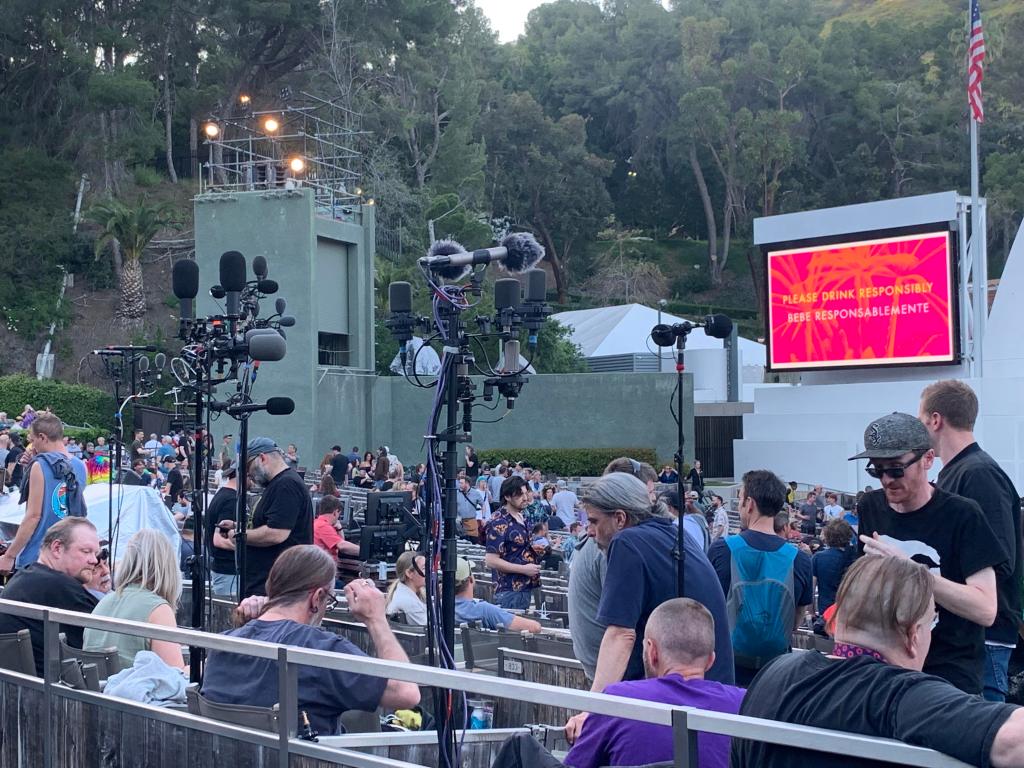
That’s the magic of taping, and I’m sure my article likey bored someone at some point. Maybe not, however. This is just an introduction and “basic” explanation to the manner in which I enjoy live music audio. I’ll always have the option to listen to the official “New Years Eve 1995 – Live at Madison Square Garden” on Spotify. I also have the option to listen to someone’s tape of the show using a pair of some old-school Nakamichi CM-300 shotgun mics pointed towards the PA stacks from halfway back in the arena. I’ll go with the second option and feel like I’m actually there, not listening to what sounds an awful lot like a studio cut with canned applause sprinkled in between songs. That’s just me though. I’ll always appreciate a good “tape,” even if we, in almost 2025, are now using SD cards the size of M&Ms with over 1 TB of storage on them.
 The Praising Pen